



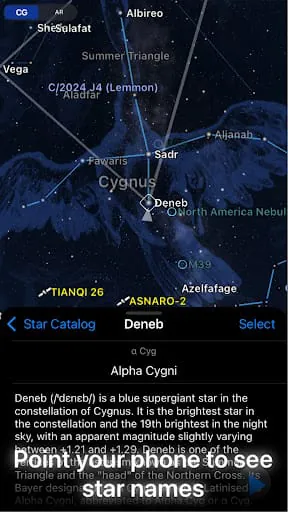
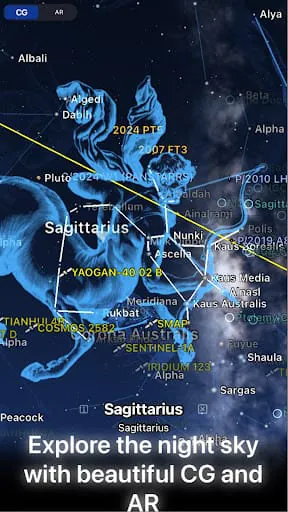
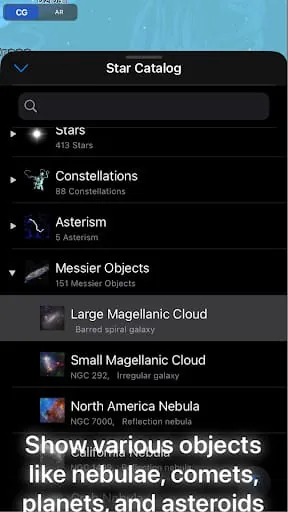
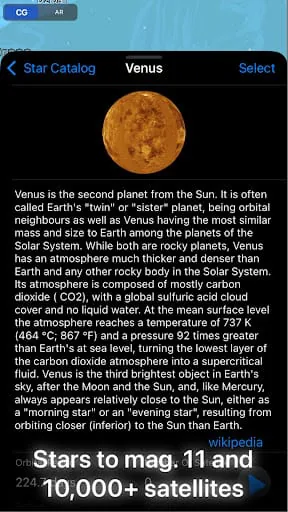
This application offers a comprehensive and engaging experience for stargazers, catering to both novice enthusiasts and experienced astronomers. Its primary strength lies in its ability to transform a smartphone into a powerful celestial identification tool. By utilizing augmented reality (AR) overlays, users can point their device at the night sky and instantly see the names of constellations, stars, and satellites superimposed on the live camera feed. This interactive approach makes learning about the cosmos intuitive and accessible, allowing for exploration in any direction with simple swipes. The application also proactively informs users with timely alerts for significant astronomical events, such as visible International Space Station (ISS) passes and the peaks of major meteor showers, ensuring users don't miss out on captivating celestial displays. The inclusion of the Quadrantids meteor shower peaking on January 3rd, with the possibility of numerous shooting stars for several days, is a prime example of the timely information provided. Furthermore, the recent addition of the interstellar object 3I/ATLAS comet adds an exciting dimension, allowing users to track and observe this ultra-fast passing object, highlighting the app's commitment to incorporating current astronomical discoveries. The breadth of content available within the application is truly remarkable and sets it apart from many similar offerings. It boasts an extensive database featuring 88 constellations, complete with historical Hevelius illustrations, offering a rich visual and educational experience. Beyond constellations, users can explore our Solar System in detail, with listings of planets, dwarf planets, and asteroids. The application's star catalog extends to stars as faint as magnitude 12, providing a significant level of detail. For deep-sky observers, the inclusion of approximately 100 Messier objects, encompassing nebulae and clusters, is invaluable. The sheer volume of data extends to over 10,000 satellites, more than 300 comets, and a wide array of meteor showers and well-known asterisms like the Summer/Winter Triangle and the Big Dipper. This extensive catalog ensures that users have access to a vast amount of celestial information, making the app a valuable resource for understanding the night sky. The app's ability to provide alerts for specific satellite passes, such as those of the ISS and the Hubble Space Telescope, and to notify users of meteor shower peak times further enhances its utility, transforming passive observation into an informed and exciting pursuit. A significant advantage of this stargazing application is its offline functionality, which greatly enhances its usability in various scenarios. While satellite data will not update when offline, the core astronomical information remains accessible, allowing users to identify celestial objects and explore constellations even in remote locations without an internet connection. This offline capability is particularly beneficial for amateur astronomers who may travel to dark sky sites away from urban light pollution, where internet access can be unreliable. The application's design prioritizes user experience through clear, intuitive navigation and informative content. The inclusion of features like the Hevelius illustrations for constellations adds a layer of historical and artistic appreciation to the scientific data. The consistent updates, such as the addition of the 3I/ATLAS comet, demonstrate an active development team that is dedicated to keeping the app current with astronomical events and discoveries. Overall, this application serves as an exceptional tool for anyone interested in exploring the cosmos, offering a blend of educational content, interactive features, and timely event notifications that make stargazing an enriching and accessible hobby for all.
4.30








 Home
 Apps
 Games
 Topics
 Google Play
 App Store